not always so by Shunryu Suzuki
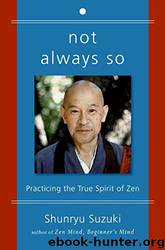
Author:Shunryu Suzuki
Language: eng
Format: mobi
Published: 2014-12-08T05:00:00+00:00
Respect for Things
"Instead of respecting things, we want to use them for ourselves, and if it is difficult to use them, we want to conquer them."
In our zazen practice we stop our thinking, and we are free from our emotional activity. We don’t say there is no emotional activity, but we are free from it. We don’t say we have no thinking, but our life activity is not limited by our thinking mind. In short, we can say that we trust ourselves completely, without thinking, without feeling, without discriminating between good and bad, right and wrong. Because we respect ourselves, because we put faith in our life, we sit. That is our practice.
When our life is based on respect and complete trust, it will be completely peaceful. Our relationship with nature should also be like this. We should respect everything, and we can practice respecting things in the way we relate with them.
This morning when we were bowing in the zendo, we heard a big noise overhead because upstairs in the dining room people were pushing chairs across the tile floor without picking them up. This is not the way to treat chairs, not only because it may disturb the people who are bowing in the zendo underneath, but also because fundamentally this is not a respectful way to treat things.
To push the chairs across the floor is very convenient, but it will give us a lazy feeling. Of course this kind of laziness is part of our culture, and it eventually causes us to fight with each other. Instead of respecting things, we want to use them for ourselves, and if it is difficult to use them, we want to conquer them. This kind of idea does not accord with the spirit of practice.
In the same way my teacher Kishizawa Ian did not allow us to put away the amado more than one at a time. Do you know the amado? They are the wooden doors outside of shoji screens, which are put up to protect the shoji from storms. At the end of the building there is a big box for storing the amado. Since they are sliding doors, one priest can easily push five or six doors, and another priest can wait and put them in the box. But my teacher didn’t like this. He told us to move them one by one. So we would slide each door and put it in the box, one door at a time.
When we pick up the chairs one by one carefully, without making much noise, then we will have the feeling of practice in the dining room. We will not make much noise of course, but also the feeling is quite different. When we practice this way we ourselves are Buddha, and we respect ourselves. To care for the chairs means our practice goes beyond the zendo.
If we think it is easy to practice because we have a beautiful building, that is a mistake. Actually it may be quite
Download
This site does not store any files on its server. We only index and link to content provided by other sites. Please contact the content providers to delete copyright contents if any and email us, we'll remove relevant links or contents immediately.
| Anthropology | Archaeology |
| Philosophy | Politics & Government |
| Social Sciences | Sociology |
| Women's Studies |
The remains of the day by Kazuo Ishiguro(9004)
Tools of Titans by Timothy Ferriss(8403)
Giovanni's Room by James Baldwin(7352)
The Black Swan by Nassim Nicholas Taleb(7137)
Inner Engineering: A Yogi's Guide to Joy by Sadhguru(6799)
The Way of Zen by Alan W. Watts(6621)
The Power of Now: A Guide to Spiritual Enlightenment by Eckhart Tolle(5789)
Asking the Right Questions: A Guide to Critical Thinking by M. Neil Browne & Stuart M. Keeley(5779)
The Six Wives Of Henry VIII (WOMEN IN HISTORY) by Fraser Antonia(5519)
Astrophysics for People in a Hurry by Neil DeGrasse Tyson(5196)
Housekeeping by Marilynne Robinson(4455)
12 Rules for Life by Jordan B. Peterson(4311)
Double Down (Diary of a Wimpy Kid Book 11) by Jeff Kinney(4278)
Ikigai by Héctor García & Francesc Miralles(4278)
The Ethical Slut by Janet W. Hardy(4262)
Skin in the Game by Nassim Nicholas Taleb(4256)
The Art of Happiness by The Dalai Lama(4133)
Skin in the Game: Hidden Asymmetries in Daily Life by Nassim Nicholas Taleb(4012)
Walking by Henry David Thoreau(3968)
